
Directory Access Protocol (DAP)
The Directory Access Protocol (DAP) is used by Directory User Agemts (DUAs) to retrieve information from a Directory System Agent (DSA). The information in the DSA is stored in entries in a hierarchical form, with each entry containing attributes that are specific to one of more object classes. DAP allows a client to list, search, add, delete, modify and rename the entries within the DSA.
If a DSA does not hold the information being searched for, it may chain the DAP operation to another DSA using DSP.
History
Protocol dependencies
-
ROS: Typically, DAP uses ROS during connection establishment (abstract syntax 2.5.3.1).
-
ACSE: Typically, DAP uses ACSE for association control (association context 2.5.9.1)
-
COTP: Typically, DAP uses COTP as its transport protocol. The well known TCP port for DAP traffic is 102, though some DSAs will often listen on other ports e.g. 19970.
Example traffic
XXX - Add example traffic here (as plain text or Wireshark screenshot).
Wireshark
The DAP dissector is fully functional, including support for signed operations.
From the source file packet-dap.c (fodder for Wiki searches)
/* packet-dap.c
 * Routines for X.511 (X.500 Directory Asbtract Service) and X.519 DAP  packet dissection
 * Graeme Lunt 2005
/* we don't have a separate dissector for X519 -
most of DAP is defined in X511 */
#define PNAME "X.519 Directory Access Protocol"Preference Settings
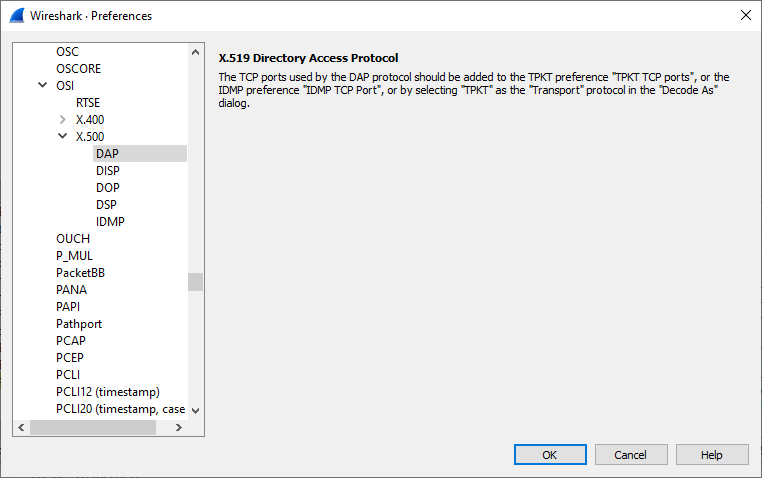
There is a single preference field for the DAP dissector, the DAP TCP Port - the port to which DAP associations are made. The default value is 102.
NOTE: moved in 31205360 :
"Have TPKT support a TCP port range preference instead of having "subdissectors?" register their own."
Example capture file
To be provided.
Attached to issue 5507: X.519 - BER: Dissector for OID:1.3.12.2.1011.5.4.1.1 and OID:1.3.12.2.1011.5.4.1.2 not implemented. Contact Wireshark developers if you want this supported
TSTI11_DSA.TRC: example trace file highlighting the missing dissector
Display Filter
A complete list of DAP display filter fields can be found in the display filter reference
Show only the DAP based traffic:
dapCapture Filter
You cannot directly filter DAP protocols while capturing. However, if you know the TCP port used (see above), you can filter on that one.
Capture only the DAP traffic over a non-standard port (19970):
tcp port 19970 External links
-
Understanding X.500 - The Directory David Chadwick's book
Discussion
Imported from https://wiki.wireshark.org/DAP on 2020-08-11 23:12:26 UTC