
Border Gateway Protocol (BGP)
BGP is the standard exterior gateway protocol designed to exchange routing and reachability information among autonomous systems (AS) on the Internet. As a path-vector protocol, BGP makes routing decisions based on paths, network policies, and rule-sets configured by administrators rather than purely on traditional technical metrics.
History
BGP was initially introduced in RFC1105 in 1989 to replace the older Exterior Gateway Protocol (EGP) and enable a fully decentralized internet routing architecture. The protocol has undergone several revisions to handle the rapid expansion of the Internet with the current standard, BGP-4, being defined in RFC4271 in 2006 to add support for CIDR.
Protocol dependencies
- TCP: Typically, BGP uses TCP as its transport protocol. The well known TCP port for BGP traffic is 179.
Example traffic
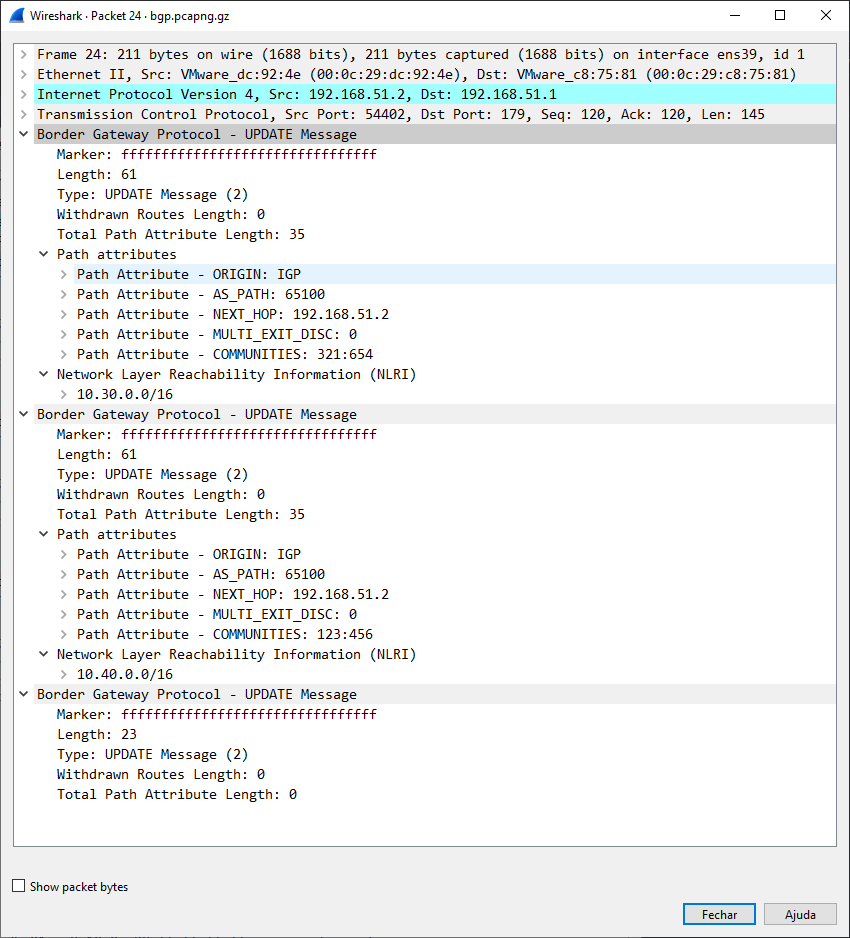
BGP sample update message.
Wireshark
The BGP dissector is (fully functional, partially functional, not existing, ... whatever the current state is). Also add info of additional Wireshark features where appropriate, like special statistics of this protocol.
Using Wireshark to decode BGP
Preference Settings
(XXX add links to preference settings affecting how BGP is dissected).
Example capture file
bgp.pcapng.gz (pcapng) BGP packets between three peers using communities and announcing six networks. The BGP implementation is FRRouting.
Display Filter
A complete list of BGP display filter fields can be found in the display filter reference
Show only BGP traffic:
bgpCapture Filter
You cannot directly filter BGP protocols while capturing. However, if you know the TCP port used (see above), you can filter on that one.
Capture BGP traffic over the default port (179):
tcp port 179External links
- RFC 1771 A Border Gateway Protocol 4 (BGP-4)
- RFC 1965 Autonomous System Confederations for BGP
- RFC 1997 BGP Communities Attribute
- RFC 2547 BGP/MPLS VPNs
- RFC 2796 BGP Route Reflection - An Alternative to Full Mesh IBGP
- RFC 2842 Capabilities Advertisement with BGP-4
- RFC 2858 Multiprotocol Extensions for BGP-4
- RFC 2918 Route Refresh Capability for BGP-4
- RFC 3107 Carrying Label Information in BGP-4
Discussion
Imported from https://wiki.wireshark.org/BGP on 2020-08-11 23:11:31 UTC